



We celebrate leaders who are fast, confident, and decisive. We promote them, book them as keynote speakers, and hold them up as models of what great leadership looks like. But a growing body of research is challenging the idea that speed and confidence under pressure produce good decisions. In fact, the science now suggests the opposite: the conditions that produce the most decisive-looking leadership are often the exact conditions that produce the worst outcomes.
Leadership decision making under pressure is one of the least examined and most consequential challenges facing organizations today. This article breaks down why smart, experienced leaders make flawed decisions in high-stakes moments, what the latest research reveals about the two-layer failure at the heart of it, and how the Clarity Loop offers a practical framework for restoring principled thinking when the pressure is highest.
Two independent research teams recently arrived at the same conclusion from different directions.
Aaron De Smet’s research at McKinsey found that under conditions of cognitive overload, every existing bias a leader carries gets amplified. Confirmation bias gets louder. Availability bias narrows the field of view. The prefrontal cortex — the part of the brain responsible for deliberate, analytical thinking — essentially goes offline, and the brain defaults to mental shortcuts. The antidote De Smet identifies is deliberate calm: intentionally slowing down at the exact moment when urgency is loudest.
Christophe Haag’s research published in Frontiers in Social Psychology scaled that individual failure to the group level. He identified what he calls Groupfeel Syndrome: the phenomenon that occurs when a team or leadership body begins operating from shared emotional pressure rather than shared analysis. When this happens, dissent gets socially discouraged. The group locks into an emotional trajectory, whether that’s urgency, optimism, bravado, or fear, and anyone who disrupts that trajectory becomes the obstacle. Critical thinking isn’t overruled. It’s quietly punished.
Together these two findings describe a two-layer failure that plays out in high-stakes leadership environments every day. Individual cognition is already compromised before the meeting begins. The group dynamic then punishes anyone who surfaces the problem. The decision proceeds, and it feels completely reasonable in the moment.
That is Decision Drift: the gradual erosion of judgment that happens when small compromises accumulate under pressure, one rationalization at a time.
The leaders most at risk from Decision Drift are not the ones with poor values or limited experience. They are the ones operating at the highest speeds, managing the most complexity, and carrying the most responsibility. The very conditions that signal leadership success — high accountability, fast-moving environments, constant decision load — are the same conditions that accelerate cognitive overload and create the social dynamics in which Groupfeel thrives.
Experience provides some protection. It also creates new vulnerabilities. The more a leader has succeeded, the stronger their existing mental models, and the more confidence they bring to the shortcuts their brain is running in high-pressure moments. Competence and bias are not opposites. Under pressure, they operate simultaneously.
The most dangerous decisions in any organization are the ones that felt, in the moment, like they had no choice.
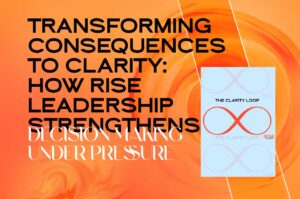
The Clarity Loop is a four-question decision framework designed to interrupt Decision Drift before it becomes a consequence. It works at both the individual level, addressing the cognitive failure De Smet’s research describes, and the group level, creating space for the deliberate thinking that Groupfeel Syndrome suppresses.
The four questions are:
1. What am I feeling right now? This is not a therapy question. It is a diagnostic one. Emotion is the first driver of cognitive bias under pressure, and until you name what you’re actually feeling in a high-stakes moment, you cannot see how much it is shaping the decision. Naming the feeling creates a brief but critical separation between the emotion and the choice.
2. What story am I telling myself? Under cognitive load, the brain fills gaps with narrative. It builds a story that justifies the direction the pressure is already pushing toward. This question surfaces that story before it becomes the decision. It is also the question most likely to break the spell of Groupfeel, because it asks each person in the room to examine their own assumptions rather than absorb the group’s.
3. What matters most here? This question returns the decision to its actual stakes. Not what feels urgent. Not what the room wants to hear. What is genuinely at stake, for the organization, the people involved, and the long-term trust the decision will either build or erode.
4. What choice can I own later? This is the accountability question, and it is the one that separates deliberate leadership from reactive decision making. It asks the decision-maker to step outside the current pressure and into the future position of having to own the outcome. Decisions made in response to this question tend to hold up in ways that decisions made purely under pressure do not.
These four questions take thirty seconds. They do not require a facilitator, a whiteboard, or an off-site. They require only the discipline to pause long enough to ask them before momentum makes the choice.
The Clarity Loop is most powerful when it becomes a shared practice rather than an individual one. When leaders normalize the four questions in high-stakes meetings, they create the conditions in which Groupfeel Syndrome cannot fully take hold. Deliberate thinking becomes the operating norm rather than a deviation from the urgency culture.
A few practical entry points for organizations:
Before any decision that carries significant consequences, create a deliberate two-minute pause. Name the pressure in the room out loud. Ask the four questions individually before the group reconvenes to decide. This single practice disrupts cognitive overload and Groupfeel simultaneously.
In leadership development programs, use real case studies to practice running the Clarity Loop under simulated pressure. The goal is not to slow decision-making in general. It is to build the muscle of deliberate thinking so it remains accessible when the pressure is highest.
In cultures where speed is rewarded above all else, the most courageous leadership move is to normalize the question: what are we not saying right now, and why? That question alone changes what a room is capable of.
Speed is often necessary. Unconscious bias is not. The Clarity Loop doesn’t ask leaders to become slower decision-makers. It asks them to become more deliberate ones. The four questions take thirty seconds. The cost of skipping them, as the research on cognitive overload and Groupfeel Syndrome shows, can be measured in years. Speed and deliberateness are not opposites. Rushing and deciding are.
Possibly more than you think. Groupfeel Syndrome is not a symptom of dysfunction. It appears in high-performing, highly cohesive teams precisely because team cohesion creates stronger social incentives to maintain the group’s emotional direction. The more your team trusts each other, the higher the relational cost of being the one who disrupts the shared momentum. Psychological safety is a valuable foundation. It is not, on its own, a guardrail against Decision Drift.
Most decision frameworks address the quality of information going into a decision. The Clarity Loop addresses the quality of thinking doing the deciding. It is not a process for gathering better data. It is a guardrail for the human cognitive and emotional conditions that determine whether available data gets used well or rationalized away. That distinction matters most in exactly the high-pressure moments when other frameworks are hardest to execute.
The Clarity Loop is not a guarantee of outcomes. It is a guarantee of intentionality. Leaders who use it consistently make decisions they can account for, learn from, and own, regardless of the outcome. In high-stakes environments where one decision can affect many people, the ability to say “here is the thinking I applied and why” is not a small thing. It is the foundation of lasting trust and long-term credibility.
It shows up most reliably at the intersection of speed, incentives, and complexity. Earnings season in financial services. Regulatory pressure in healthcare. Competitive urgency in tech. Merger and acquisition activity in any sector. Anywhere that the pace of decisions outstrips the organization’s capacity to examine them. These are the environments where guardrails for thinking are not optional. They are the difference between leadership and drift.
Leadership decision making under pressure is not a problem of intelligence, experience, or intention. It is a problem of conditions. When cognitive load is high and group dynamics suppress dissent, even the most capable leaders drift. The research is clear on this. The solution is not more willpower or better values. It is a structured practice of deliberate thinking, applied consistently, before the pressure makes it feel impossible.
Rashmi Airan is a global keynote speaker on leadership and decision making. Her work on Decision Drift and the Clarity Loop has reached audiences at Coca-Cola, Merck, Cardinal Health, Comcast, and organizations across financial services, healthcare, and law. Learn more at rashmiairan.com.
Sources
De Smet, Aaron. “Bias Busters: How Cognitive Overload Multiplies Every Bias.” McKinsey & Company, February 3, 2026. https://www.mckinsey.com/capabilities/strategy-and-corporate-finance/our-insights/bias-busters-how-cognitive-overload-multiplies-every-bias
Haag, Christophe. “[Article Title TBD].” Frontiers in Social Psychology, February 2, 2026. DOI: 10.3389/frsps.2026.1669672. https://www.frontiersin.org/journals/social-psychology/articles/10.3389/frsps.2026.1669672/full