



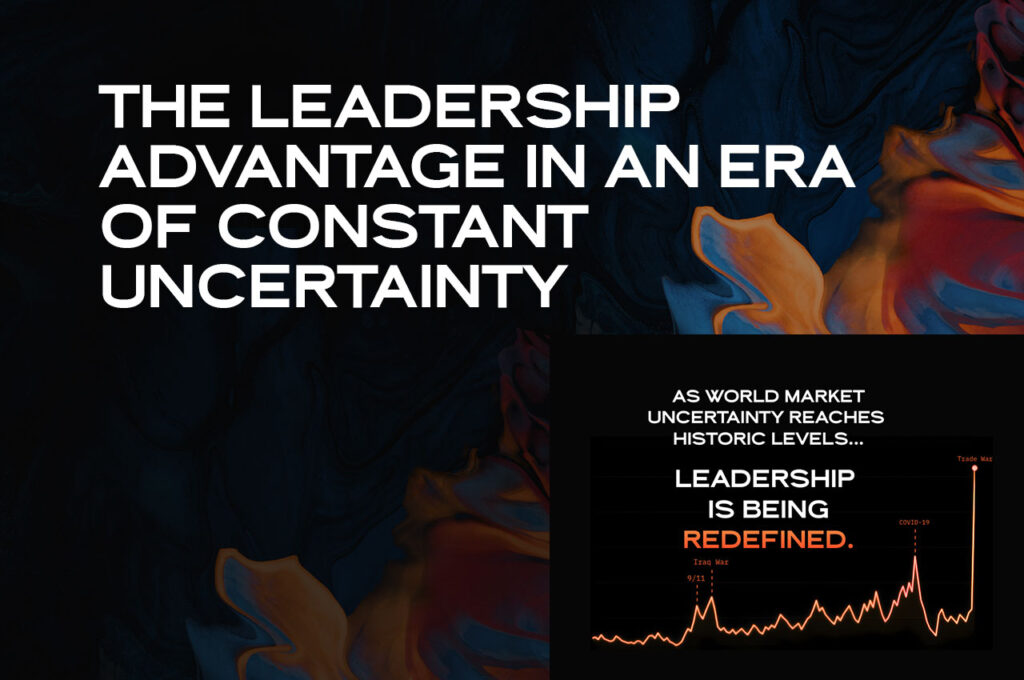
Uncertainty is no longer a temporary disruption.
It is the operating system.
From economic volatility to geopolitical instability, from rapid technological change to cultural shifts in the workplace, leaders are navigating conditions that feel persistently unstable. According to the World Uncertainty Index, global uncertainty levels have surpassed previous crisis periods.
But here is the deeper question.
What if uncertainty is not just a threat to leadership, but a filter?
In this environment, leadership is being refined, exposed, and redefined in real time.
In predictable markets, strategy drives confidence.
In volatile markets, behavior drives confidence.
When uncertainty becomes prolonged rather than episodic, teams stop looking for perfect forecasts. They start looking for emotional signals.
They notice:
• Tone shifts in meetings
• Delayed decisions
• Inconsistent messaging
• Defensive reactions under pressure
The external environment may be unstable, but what destabilizes organizations most often is internal inconsistency.
The advantage does not go to the leader with the most information.
It goes to the leader with the most steadiness.
Under sustained uncertainty, leaders often default to one of three patterns:
Overcontrol
They tighten oversight, reduce autonomy, and attempt to manage every outcome.
Overanalysis
They delay decisions waiting for more data, more clarity, more certainty.
Overdrive
They push harder, believing intensity will compensate for instability.
All three reactions are understandable. None of them create long term trust.
Fear driven leadership shrinks creativity. It narrows collaboration. It signals scarcity rather than strength.
And teams feel it immediately.
The leaders who rise in volatile conditions share a common trait.
They separate what they can influence from what they cannot.
They do not deny uncertainty. They normalize it.
They do not pretend confidence. They cultivate clarity.
This is where Rise Through It® becomes a strategic leadership advantage.
Not as inspiration. As discipline.
Stop resisting the fact that uncertainty is present. Treat it as the terrain, not the obstacle.
When leaders stop fighting reality, energy shifts toward adaptation.
High uncertainty fragments teams. People withdraw or compete.
Intentional connection restores cohesion. Psychological safety becomes a performance driver, not a soft skill.
Control is not the same as leadership.
The more leaders attempt to dominate uncertainty, the more tension they create. The more they focus on aligned action and clear priorities, the more confidence builds.
Momentum stabilizes culture.
Thoughtful action, even imperfect action, signals progress. Waiting for certainty rarely produces it.
In this era of constant uncertainty, organizations must rethink how they define strong leadership.
It is no longer about:
Having all the answers
Projecting unwavering certainty
Avoiding visible doubt
It is about:
Communicating clearly under pressure
Making values aligned decisions
Modeling emotional regulation
Building trust through consistency
Leadership development must shift from skill acquisition to self mastery.
Because in unstable conditions, the leader is the climate.
Many leaders are waiting for the return of stability.
But volatility is becoming structural. Markets will continue to shift. Technology will accelerate. Public expectations will evolve. The pace will not slow.
The leaders who thrive will not be those who wait for calm.
They will be those who know how to stand steady inside of movement.
Uncertainty does not eliminate opportunity.
It exposes leadership.
And exposure can either weaken you or refine you.
Uncertainty disrupts planning assumptions, increases emotional stress, and narrows decision making confidence. Leaders must compensate by strengthening communication, trust, and clarity when external variables cannot be controlled.
Emotional regulation, decisiveness, transparency, adaptability, and the ability to build psychological safety are critical during prolonged instability.
Confidence in uncertain conditions does not come from guarantees. It comes from alignment. Leaders who anchor decisions in clear values and consistent principles build trust even when results are unpredictable.
The most common mistake is attempting to overcontrol outcomes. This creates tension, reduces autonomy, and signals fear to teams.
Rise Through It® provides a disciplined approach to navigating complexity. It encourages leaders to reframe challenges, strengthen connection, release unnecessary control, and evolve through deliberate action. It is particularly effective for executive teams facing sustained market volatility.