



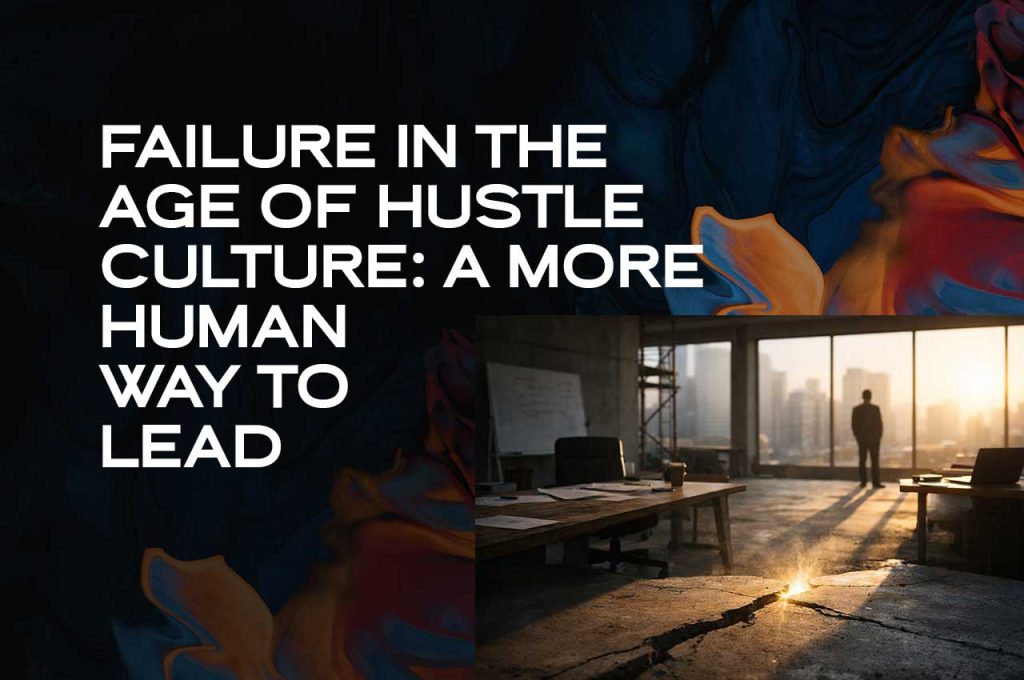
In a culture obsessed with scale and speed, who is actually stopping to learn when things break?
Across industries and organizations, leaders are operating under constant pressure. Move faster. Stay relevant. Deliver results. Do not pause too long or risk falling behind.
Hustle culture has become the default operating system of modern leadership. It rewards momentum, visibility, and outcomes. What it rarely asks is what that pace costs leaders and the people they lead.
Failure has not disappeared from business or leadership.
It has simply become something we rush past, hide, or reframe before we truly understand it.
Failure is not always dramatic. Often, it is quiet.
It is the meeting where something felt off and you stayed silent.
The decision made under pressure that did not fully align with your values.
The exhaustion you normalized because everyone else seemed to be pushing through.
Most leaders feel these moments before they name them. A tightness. A constant urgency. A sense of being behind even when things look successful on the outside.
The issue is not failure itself.
The issue is how quickly we try to outrun it.
Hustle culture treats failure as inefficiency.
If something goes wrong, the instinct is to fix it quickly, control the narrative, and keep moving. Pausing feels risky. Reflection is mistaken for hesitation. Confidence becomes something to perform rather than something grounded.
But most leadership failures are not technical. They are human.
They come from blind spots, fatigue, fear of slowing down, and stories we tell ourselves about urgency and control. Over time, leaders stop asking deeper questions. Teams learn what not to say. Organizations optimize for speed instead of truth.
What looks like progress is often avoidance.
Failure is not the opposite of success.
It is a mirror.
It reflects the beliefs we were holding, the pressures we were carrying, and the values we may have compromised without realizing it.
Failure asks questions success never does.
What was I afraid to face
What assumptions was I operating under
Who was I trying to please
What truly mattered and what did I ignore
These questions are uncomfortable. They are also where leadership deepens.
RISE does not come from fixing failure quickly or turning it into a neat lesson. It comes from facing failure honestly, without shortcuts or shame, and allowing it to shape wiser choices.
Leaders who grow do not pretend to have it all figured out. They pause. They listen. They reflect before reacting.
They separate accountability from self judgment.
They tell the truth about what went wrong without blame.
They create cultures where learning matters more than performance.
When leaders do this, trust builds. Conversations become more honest. People feel safer speaking up. Failure becomes a source of wisdom instead of fear.
This is what sustainable leadership looks like.
Think of one recent decision, conversation, or outcome that did not sit right.
Not the one you already resolved.
The one you moved past because there was no time.
Ask yourself
What actually happened
What was driving me in that moment
What do I see now that I could not see then
This reflection is not about optics.
It is about clarity.
I have learned that the most meaningful growth in my life and leadership did not come from success. It came from moments when things broke and I stopped trying to outrun the truth.
Hustle may celebrate success.
RISE is built when we slow down, face failure honestly, and choose to evolve.
That is how leaders grow.
That is how trust is built.
And that is how we become the kind of leaders the world needs right now.