





Rise to Clarity: How to Lead When Speed Is Working Against You
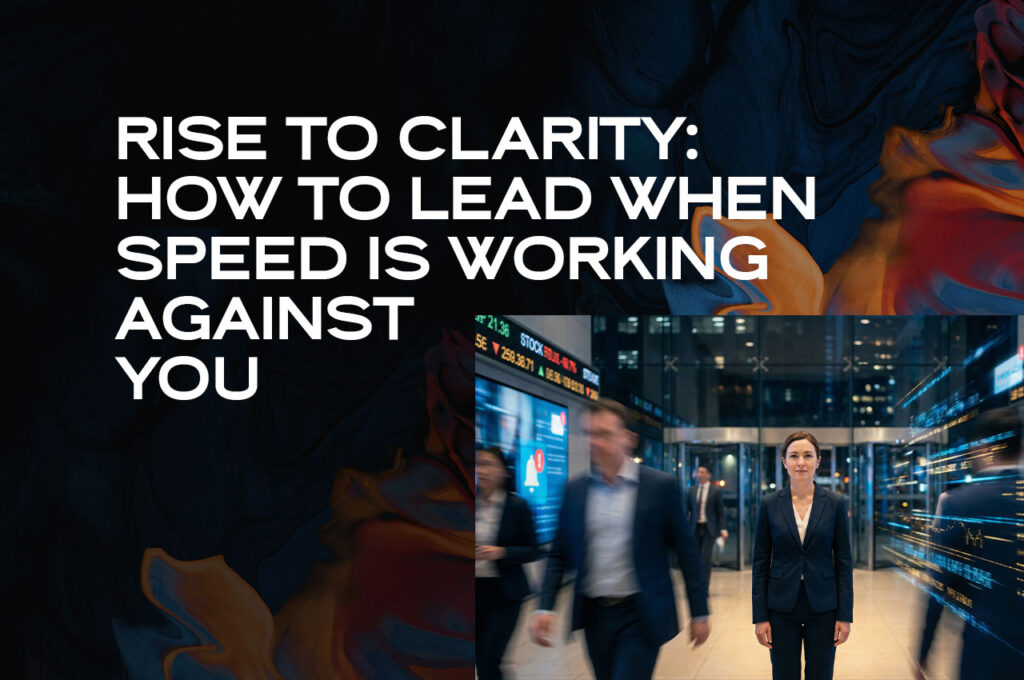
Why Leaders Today Are Struggling with Decision Making
We are living in one of the fastest decision making environments in history.
Information moves instantly.
Expectations are high.
Technology has removed the natural pauses that once existed.
Leaders are not stuck or indecisive.
They are moving quickly. Often too quickly.
And that’s where the real problem begins.
The challenge today is not a lack of action.
It is a lack of clarity inside action.
The Hidden Risk: Decision Drift in High-Speed Environments
When decisions are made under constant urgency, something subtle happens.
We stop questioning what is driving our choices.
Instead, decisions become shaped by:
- Pressure to respond quickly
- Fear of missing out or falling behind
- External expectations
- Emotional reactions
- Cognitive biases
This is what I call decision drift.
It does not happen all at once.
It happens gradually, through small moments where we react instead of reflect.
Over time, those moments compound.
And the cost shows up in:
- Misalignment in leadership
- Breakdown of trust within teams
- Poor long-term outcomes
- Decisions we struggle to stand behind later
Why Speed Is Not the Same as Strong Leadership
There is a belief in modern leadership that speed equals capability.
That being decisive means being fast.
But speed without intention creates risk.
Strong leadership is not about reacting first.
It is about thinking clearly before acting.
In today’s environment, that requires a different skill set.
Not more intelligence.
Not more effort.
But a better way to think under pressure.
Clarity Is a Discipline, Not a Feeling
Many leaders are waiting to feel clear before making decisions.
That clarity rarely comes.
Because clarity is not something we find.
It is something we build.
Clarity is created through structure.
Through intentional thinking.
Through the questions we ask in critical moments.
Without that structure, we default to automatic thinking.
And automatic thinking is shaped by bias, pressure, and noise.
The Clarity Loop: A Practical Framework for Better Decisions
To navigate this, I developed a simple decision making framework called the Clarity Loop.
It is designed to create a pause within fast-moving environments.
Not to slow leaders down.
But to help them think better in the time they already have.
At its core, the Clarity Loop is built on a few essential questions:
- What is driving my urgency right now?
- What might I be missing?
- Who do I want to be in this moment?
- Will this decision hold up over time?
These questions are not about finding perfect answers.
They are about shifting how we think before we act.
That shift is where clarity begins.
How This Applies Beyond Leadership
This is not just a leadership issue.
The same pattern shows up in every part of life.
In families, where reactions replace meaningful conversations.
In health, where we override what we know we need.
In communities, where decisions are made without full understanding.
The ability to pause and think clearly is no longer optional.
It is essential.
How to Start Building Clarity Today
You don’t need more time to make better decisions.
You need better awareness in the time you already have.
Start here:
Before your next decision, especially one that feels urgent, pause.
Ask one better question.
Create a moment of awareness before action.
That single shift can change the quality of your decisions immediately.
Final Thought
We are not struggling because we are incapable.
We are struggling because we are operating at a speed that bypasses reflection.
Clarity is not coming.
It is created.
And the leaders who rise will be the ones who learn how to create it in the moments that matter most.
FAQs
What is decision drift in leadership?
Decision drift refers to the gradual shift away from intentional decision making due to pressure, urgency, and external influences. It often occurs when leaders react quickly without fully evaluating their choices.
Why is speed dangerous in decision making?
Speed can lead to reactive thinking, where decisions are made based on emotion, pressure, or incomplete information. Without intentional reflection, fast decisions often create long-term consequences.
What is the Clarity Loop?
The Clarity Loop is a decision making framework designed to help individuals think more intentionally in high-pressure situations by asking structured, reflective questions before acting.
How can leaders improve decision making under pressure?
Leaders can improve decision making by creating small pauses, asking better questions, and becoming aware of the internal and external factors influencing their choices.
Why is clarity important in leadership?
Clarity allows leaders to make aligned, intentional decisions that build trust, improve outcomes, and create consistency across teams and organizations.
Other Blogs







Other Blogs