





Coach Dean Smith and the Leadership Lesson I Carry Into Every Room
Every basketball season, something in me naturally drifts back to Chapel Hill. The sound of sneakers on wood. The buzz before tip off. The familiar hope that this might be our year.
And every time, I think of Coach Dean Smith.
Not first for the banners or the titles, even though those are part of the story. I think of how he made people feel. How he held excellence and humanity in the same hand. How he could demand your best without ever making you feel small.
That kind of leadership leaves a mark.
What I noticed about Coach Smith that I did not expect
Coach Smith coached hard. Everyone knew that. Practices were demanding. Standards were sky high. But players also knew, deep in their bones, that he was for them. Not only as athletes, but as young men becoming who they were going to be.
I have always believed that people rise in hard moments only when they feel safe enough to learn in public. Coach Smith created that kind of environment. He did not treat mistakes like proof you were unworthy. He treated mistakes like material. Like a doorway.
A blown assignment became film study.
A tough loss became a conversation about character.
A bad night became a chance to build something deeper than confidence.
He did not sugarcoat struggle. He did not rescue people from it. He walked them through it. He taught them how to respond when pressure, criticism, or failure showed up. Not with excuses. Not with blame. With ownership. With humility. With steadiness.
That is leadership.
Integrity that showed up in the small moments
What I admired most is that his integrity was not performative. It was quiet. Consistent. Lived.
He asked the question so many leaders avoid, who will this affect. He chose fairness when it would have been easier to look away. He spoke up on racial justice and education. He refused to let winning excuse cutting corners.
He showed that integrity is not only what you do when the stakes are high and everyone is watching. It is what you do when nobody is watching. It is the small daily decisions that shape the culture and shape the people inside it.
I think about that a lot right now, because leadership today can feel so loud. Everyone is trying to be seen. Everyone is trying to be right. Everyone is trying to win the moment.
Coach Smith did not chase moments. He built a legacy.
The moment I met Coach Smith, and why it still matters to me
I was lucky enough to experience his kindness up close, in a way I will never forget.
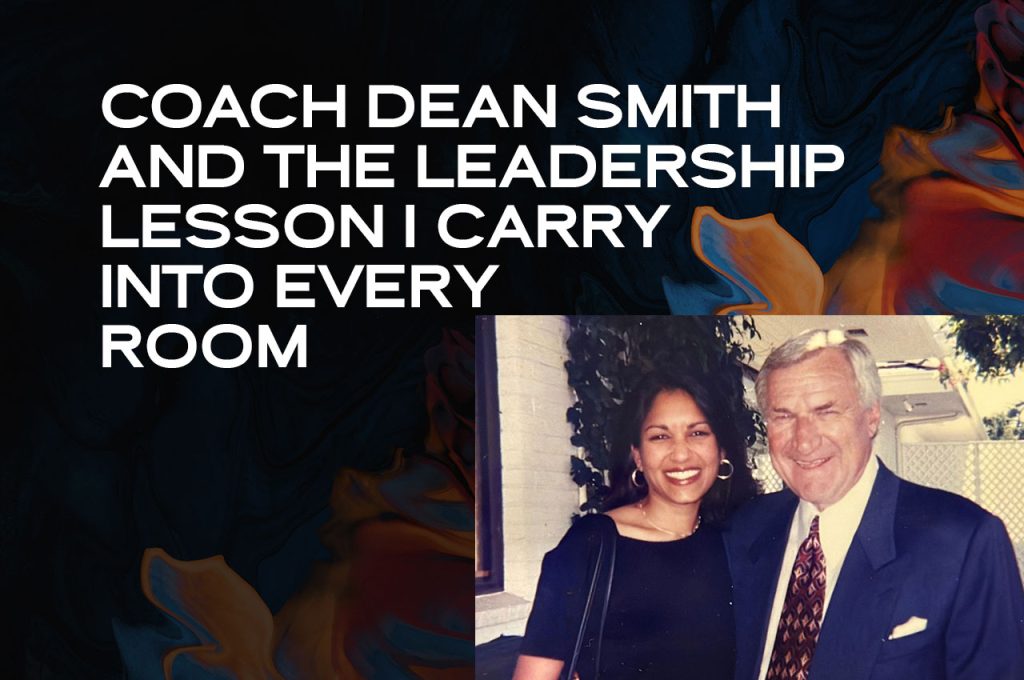
My dear friend George Lynch, captain of our 1993 championship team when I was a senior, sat me next to Coach Smith at his wedding. I remember feeling a little star struck, not in a flashy way, but in a quiet, childlike way. This was Coach Smith.
But what happened next is what made the moment unforgettable.
He was slow and thoughtful. He asked real questions. He listened like he meant it. He was not scanning the room. He was not performing. He was present. He made me feel like I mattered, even though he could have been talking to anyone else in that room.
And then I danced with him.
No spotlight. No crowd noise. Just a humble man moving through a simple moment with warmth and ease. Fully there with the people around him. I did not walk away thinking, what a legend. I walked away thinking, what a good human.
That is what stays with me.
We lost Coach Smith to Alzheimer’s too soon. That grief still sits with so many Tar Heels, and honestly, with so many people who never even met him. Because he represented something steady. Something decent. Something that feels harder to find in the world sometimes.
What I do with this lesson when I walk on stage
As this season unfolds, and the Dean Dome fills with that familiar Carolina energy, I keep thinking about what I see when I step onto a stage today.
I can look out at a room of leaders and feel the weight they are carrying. The pressure to perform. The fear of getting it wrong. The responsibility of making decisions that affect real people. So many of them want to lead with strength, and they also want to stay human.
So I offer a different set of questions, the kind Coach Smith lived, and the kind my clients are practicing in real time:
Am I holding high standards while still protecting dignity
Am I using hard moments to develop people, not manage them through fear
Am I creating a culture where truth can be spoken early, before it becomes damage control
Am I choosing integrity in the small everyday decisions, not only when the spotlight is on
And then we do not leave them as nice questions.
We turn them into action.
We practice what it sounds like to give direct feedback without humiliation. We practice how to own a mistake without spiraling into shame. We practice how to pause before reacting, so fear does not drive the decision. We practice how to build trust in the moments that usually get rushed or avoided.
Because most leaders do not need more motivation. They need language. They need tools. They need a way to lead with backbone and still keep their heart open.
That is what I come to the stage to do.
A simple practice you can use this week
If you want a practical way to apply this immediately, try this before your next hard conversation:
Pause for two breaths and ask yourself one question.
Will my next sentence protect this person’s dignity while still telling the truth
Then say the truth clearly, without sharpness. Name the standard. Name what you believe they are capable of. Ask a question that turns the moment into learning.
Here is a line you can use:
What do you want this moment to teach you, and what support would help you act on it
This is how cultures change. Not through slogans. Through repeated moments where people feel both challenged and respected.
The leadership lesson I hope we carry forward
Most of us will never coach in the Dean Dome. Most of us will never have our name chanted by a crowd.
But every one of us leads somewhere.
In a meeting. In a hallway conversation. In a text message. At a dinner table. In the way we correct. In the way we encourage. In the way we show up when someone is struggling.
Coach Smith did not only win games. He shaped lives. He showed us that you can pursue excellence without losing your humanity. That you can hold people accountable while still holding them with care. That you can compete fiercely and still lead with conscience.
Thank you, Coach Smith. For the wins, yes, and even more for the way you showed us what true leadership can look like.
Other Blogs








Other Blogs